📦FREE SHIPPING ON ALL ORDERS🍄 Dismiss
Skip to content
Mushroom spores are microscopic reproductive cells responsible for the spread and survival of fungi. Unlike seeds, spores contain no stored nutrients. Instead, they rely entirely on the surrounding environment to activate and begin growing. This process is a foundational step in mushroom cultivation and wild propagation alike.
Spores are typically released from the gills, pores, or surface of a mature mushroom’s cap. Each spore contains one half of the genetic material needed to form mycelium. They are usually produced in enormous quantities to increase the odds of successful colonization, as most will never land in a suitable environment.
Spores are microscopic and can only be seen en masse, often as a fine powder. Their colors can vary between species and are sometimes used to identify mushroom types.
Successful germination requires very specific environmental conditions:
Spores that land in dry, sterile, or overly hot environments are unlikely to germinate.
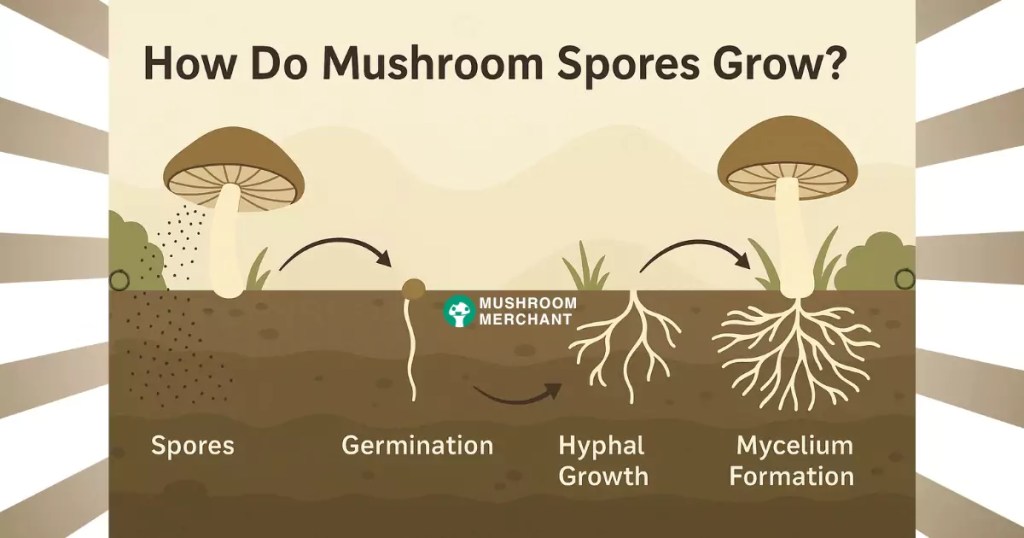
Once a spore absorbs enough moisture and oxygen, it begins to germinate. This involves the emergence of a small filament called a hypha.
The initial hypha elongates and branches out in search of compatible hyphae. When two compatible hyphae meet, they fuse and exchange nuclei, forming a dikaryotic cell. This fusion is essential for further development.
The connected network of fused hyphae expands rapidly into a dense web called mycelium. This white, thread-like structure colonizes the surrounding substrate, digesting organic matter and absorbing nutrients.
Mycelium is the primary life stage of most fungi and can persist for months or years underground or within a substrate before producing fruiting bodies.
In controlled environments, spores are usually introduced via a spore syringe into sterile agar or sterilized grain. Cultivators observe growth on agar to isolate clean, vigorous strains before transferring them to larger substrates for full colonization and fruiting.
Unlike liquid culture, which contains living mycelium, spores require time to germinate, making the process slower but valuable for strain development and storage.
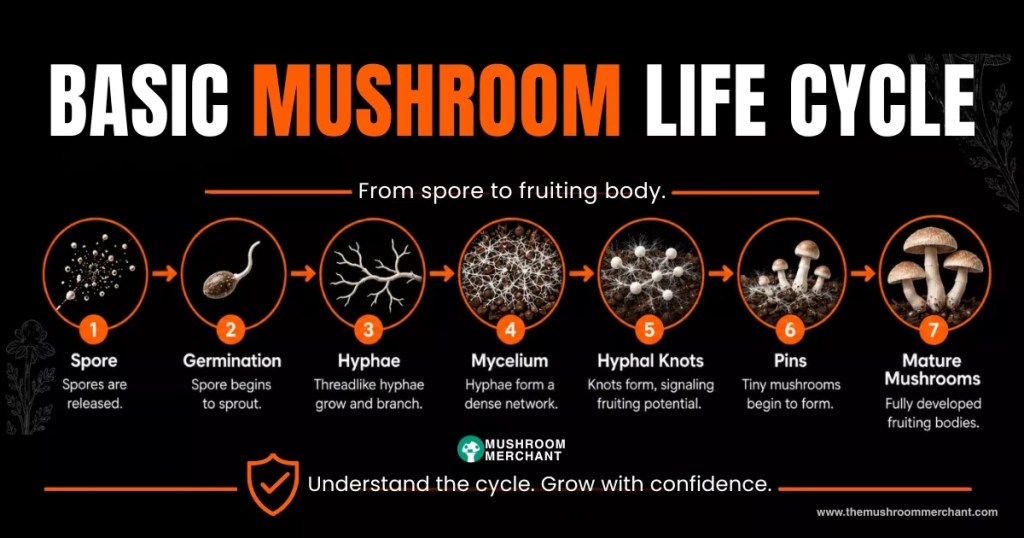
A mushroom starts with a tiny spore. When that spore lands in the right conditions, it can germinate and begin growing threadlike strands called hyphae. As those hyphae spread and connect, they form mycelium, which is the white network that colonizes grain, substrate, or agar. Once the mycelium is strong and environmental conditions are right, it begins preparing to fruit. One early sign is the formation of hyphal knots, which are tiny white bumps where the mycelium starts organizing itself. These can later develop into mushroom pins, which are the first visible baby mushrooms with a small stem and cap shape. Understanding the difference between hyphal knots and mushroom pins can help growers know what stage their grow is in and what to expect next.
Mushroom spores grow by activating under specific conditions, producing hyphae, and forming a web-like mycelial structure. This process is natural and efficient, yet delicate. For cultivators, understanding how spores grow is essential to developing clean, strong cultures that lead to productive harvests.
Spores usually germinate within 3 to 7 days. Full mycelial growth may take 1 to 3 weeks depending on conditions and species.
Spores themselves are invisible, but once they germinate, the resulting mycelium becomes visible on agar or grain within a few days.
Yes. Light is not needed during spore germination or mycelium growth, but it may be required during mushroom formation.
They may be too old, stored improperly, or exposed to poor conditions. Contamination is also a common issue that prevents growth.
Spores are great for strain discovery and long-term storage. Liquid culture is faster and better for beginners or bulk production.
Learn More About Mycology
Get updates and learn about growing mushrooms