📦FREE SHIPPING ON ALL ORDERS🍄 Dismiss
Skip to content
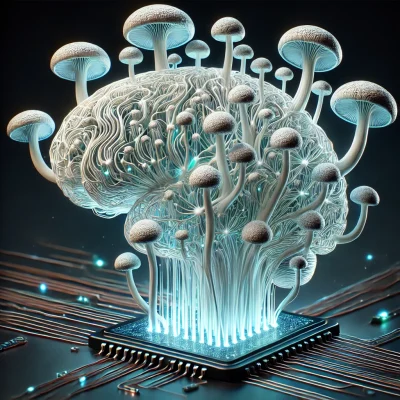
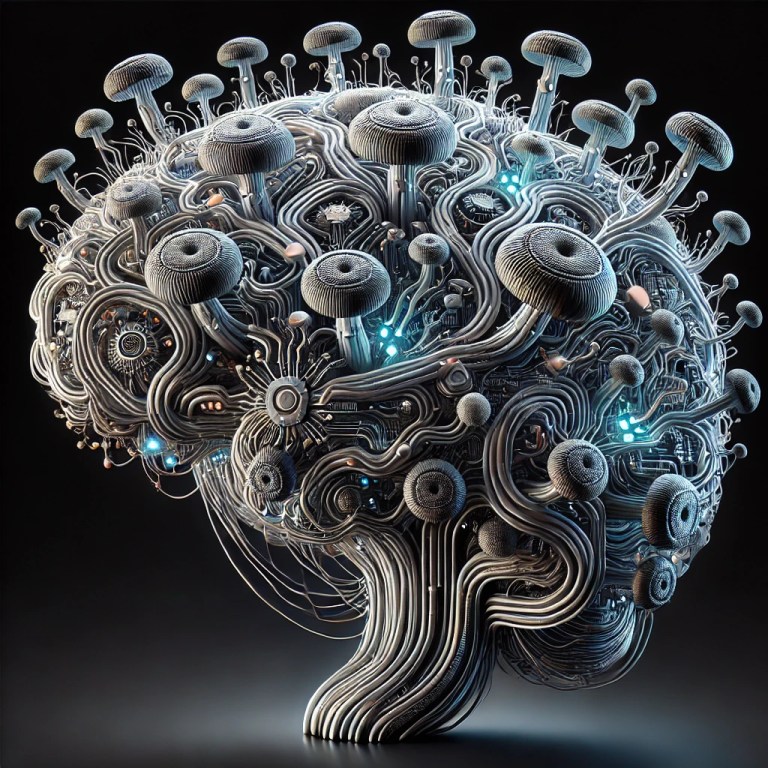
In the hidden depths of forests and soil, an extraordinary network exists—one that bears an uncanny resemblance to the complex web of neurons in our brain. This network is known as mycelium, the vegetative part of fungi, composed of fine, thread-like structures called hyphae. While mycelium may look like a simple, sprawling web, it plays a vital role in nature, facilitating communication, nutrient exchange, and even environmental repair.
But what’s truly fascinating is how closely mycelium mirrors the neural networks in our brains. Beyond its visual similarity, mycelium functions in ways that are deeply aligned with the principles of intelligence, cooperation, and problem-solving.
The mycelium network is often referred to as nature’s internet or Wood Wide Web. It forms a vast underground system that connects different plants and trees, allowing them to communicate with each other. Through this network, plants can exchange nutrients, send warning signals about disease or pests, and even bolster each other’s immune systems.
Much like neurons in the human brain, which transmit electrical impulses to share information, mycelium networks use chemical signals to facilitate the exchange of resources and knowledge among ecosystems. This decentralized communication system is key to the survival and resilience of entire forests. In this way, mycelium acts as an intelligent organism, constantly adapting to the needs of its environment.
While the comparison between mycelium and neural networks is visually obvious—both structures are branching, web-like systems—the parallels extend much deeper. Neural networks in the brain enable learning, memory, and adaptation through the formation and strengthening of connections between neurons. Similarly, mycelium networks form connections between plants and trees, fostering cooperation and mutual support.
Interestingly, both systems exhibit emergent behavior—complex outcomes arising from simple interactions. In neural networks, learning happens through the strengthening of certain pathways based on repeated use. In mycelium networks, growth occurs in the direction that best supports the needs of the surrounding ecosystem. These systems are decentralized, meaning they don’t rely on a single control point, but instead function as distributed networks. This characteristic allows both neural and mycelial systems to be resilient, adaptable, and capable of solving complex problems.
As researchers continue to explore the similarities between mycelium networks and neural networks, mycelium is inspiring new models in the field of artificial intelligence. AI systems modeled after biological networks, like mycelium, are designed to be decentralized, self-organizing, and capable of solving problems in dynamic environments.
In fact, some researchers have experimented with using fungal mycelium in computing, due to its adaptive growth patterns. These studies show that mycelium can efficiently solve problems, such as finding the shortest path between two points, much like algorithms used in AI for optimization.
The implications are profound: studying mycelium could lead to breakthroughs in AI and network design that mimic nature’s resilience and efficiency. Just as our brains rely on connections to process information and adapt, AI systems inspired by mycelium might become more autonomous, self-repairing, and capable of learning in ways we’ve yet to fully explore.
The more we study mycelium, the more we understand that intelligence isn’t limited to brains or computers. Nature has been developing sophisticated systems of communication and cooperation for millions of years. Mycelium teaches us that intelligence can emerge from interconnection and cooperation, rather than centralized control.
It also reminds us of the importance of balance and symbiosis. In forests, mycelium ensures that resources are shared and that ecosystems function as a whole. Similarly, in human society and technology, the most successful systems may be those that prioritize collaboration and adaptability over competition and rigid control.
In the same way that neurons in our brain form networks to enable thought, mycelium connects life in the soil to form a collective intelligence that sustains ecosystems. As we continue to learn from nature, the parallels between mycelium and neural networks may guide us toward a future where technology, inspired by biology, is more resilient, efficient, and adaptable. The humble mycelium, with its intricate web of connections, may be the key to unlocking new frontiers in understanding intelligence, cooperation, and even the future of AI.
Learn More About Mycology
Get updates and learn about growing mushrooms