📦FREE SHIPPING ON ALL ORDERS🍄 Dismiss
Skip to content
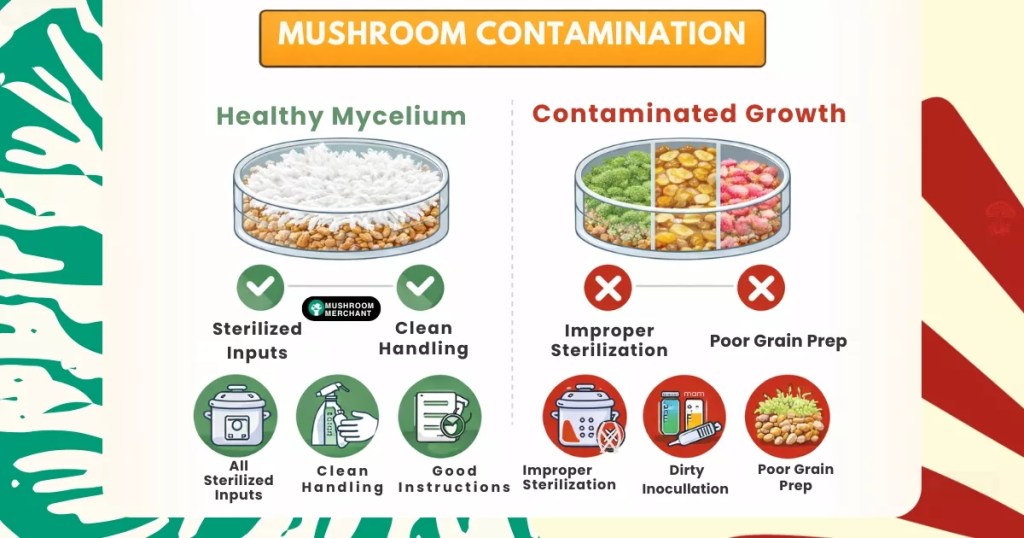
Mushroom contamination occurs when unwanted organisms—molds, bacteria, or yeasts—outcompete mushroom mycelium. These contaminants exist everywhere: in the air, on surfaces, on tools, and inside improperly prepared materials.
For most growers, contamination is not caused by bad luck. It is caused by unclean inputs, improper sterilization or pasteurization, or poor handling practices early in the process.
A critical point to understand from the start:
Short answer: No—always discard it.
Once contamination becomes visible, it has already spread microscopically throughout the material. Cutting out mold, spraying alcohol, or isolating sections does not remove embedded spores or bacteria.
Continuing a contaminated grow increases the risk of spreading spores throughout your grow area and into future projects.
If contamination appears, the correct response is to discard the grow and restart with clean materials.
Many older mushroom cultivation guides emphasize constant alcohol spraying, excessive glove use, and near-obsessive surface sterilization. This approach developed largely because home-prepared grain and substrate are inherently high-risk.
When inputs are inconsistent, growers compensate with:
While cleanliness matters, alcohol cannot fix contaminated materials. If bacteria or mold survives inside grain or substrate, no amount of surface sterilization will save it.
Modern cultivation focuses less on paranoia and more on eliminating contamination at the source.
Below are the most common contamination types encountered in mushroom cultivation.
Appearance
What Causes It
Can It Be Fixed?
In both small-scale and commercial cultivation, Trichoderma is most often traced back to grain preparation rather than fruiting conditions.
Appearance
What Causes It
Can It Be Fixed?
Avoid opening contaminated materials indoors, as mold spores can be harmful to breathe.
Appearance
What Causes It
Can It Be Fixed?
Cobweb mold is often mistaken for mycelium early on. Speed of growth is the clearest indicator.
Appearance
What Causes It
Can It Be Fixed?
Bacterial contamination often originates weeks earlier during grain preparation, even if symptoms appear later.
Appearance
What Causes It
Can It Be Fixed?
Appearance
What Causes It
Can It Be Fixed?
Healthy mycelium:
Contamination often shows:
When in doubt, discard.
Most contamination originates from:
Genetics and luck play a far smaller role than most growers assume.
A significant portion of contamination issues come from preparing grain at home.
Grain must be:
Even small inconsistencies—slightly excess moisture or under-sterilization—allow bacteria to survive inside kernels and surface weeks later.
Most home setups cannot replicate the pressure stability, filtration, and repeatability of professional systems.
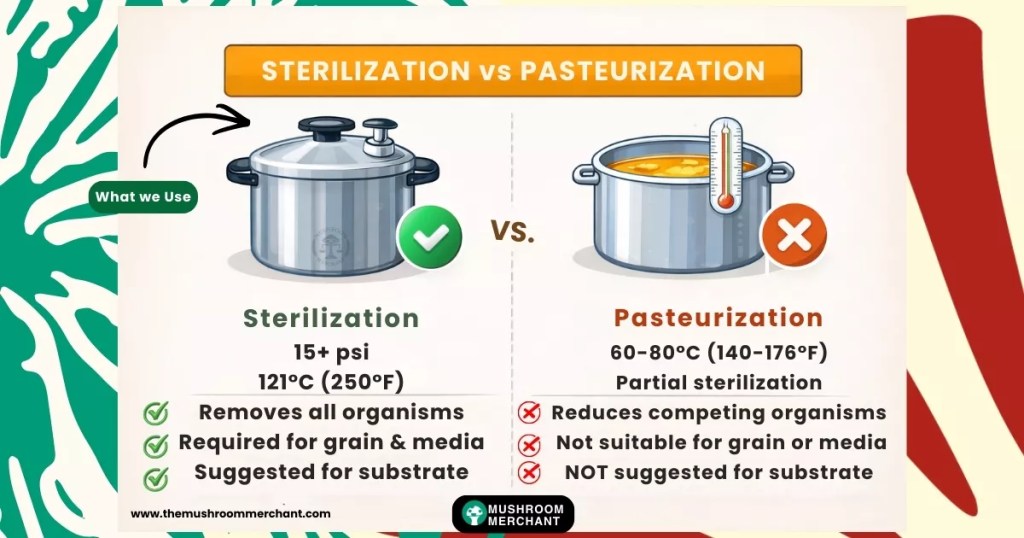
These two terms are often confused, but they are not interchangeable.
Using pasteurization where sterilization is required is one of the most common causes of contamination in home grows. All of our grain, media, and substrate are sterilized.
Professionally prepared grain and media are properly sterilized, not approximated.
Not all contamination originates from grain or substrate. Inoculation sources—such as spore syringes and liquid culture—can also introduce contamination if improperly prepared or handled.
Bacterial contamination in liquid culture may not be immediately visible and can quietly spread once introduced to grain.
This is why many growers use agar as a diagnostic tool. Testing spores or liquid culture on agar allows contamination to be identified early, before committing it to grain or bulk substrate. Agar does not prevent contamination, but it reveals it.
A reasonably clean grow environment matters, especially during inoculation and early colonization. Excessively dirty spaces, heavy dust, visible mold, or constant air disturbance can increase contamination risk.
That said, most contamination does not originate from normal living spaces. It comes from contaminated inputs or improper preparation earlier in the process.
Using properly prepared, sterilized materials removes the highest-risk steps and allows growers to succeed without turning their home into a laboratory.
Clean does not mean sterile. It means:
Start with clean, professionally prepared inputs.
Most contamination risk follows a simple hierarchy:
Removing the first two eliminates the majority of failures.
Reputable manufacturers operate in controlled, lab-grade environments with documented sterilization cycles, controlled hydration ratios, and repeatable processes refined through constant production.
This results in materials that are:
Immediately if you observe:
Delaying disposal increases spore spread and contamination risk for future grows.
Many growers struggle not because mushroom cultivation is difficult, but because they attempt to do everything at once without industrial-level tools.
Clean, professionally prepared materials remove the most common failure points and allow growers to focus on learning the organism and dialing in fruiting conditions.
Less contamination means fewer restarts, lower stress, and better results.
Mushroom contamination is not inevitable. It is almost always preventable.
Once contamination appears, the correct response is to discard the grow, clean thoroughly, and restart with clean, tested materials. Prevention—through proper preparation and trusted inputs—remains the most effective strategy.
The most common type of mushroom contamination is green mold, also known as Trichoderma, which is highly aggressive and often originates from improperly sterilized grain.
Contaminated mushroom grows cannot be reliably saved or fixed, and the safest and most effective action is to discard them immediately.
Mushroom contamination often starts in grain because grain is nutrient-dense and must be fully sterilized, and even small preparation errors can allow bacteria or mold to survive inside the kernels.
Spore syringes and liquid culture can cause contamination if they are improperly prepared or handled, which is why many growers test them on agar before using them.
Breathing mold spores from contaminated mushroom grows can be harmful, so contaminated materials should not be opened indoors.
Buying professionally prepared grain and substrate significantly reduces contamination risk because these materials are properly sterilized in controlled, lab-grade environments.
A mushroom grow area needs to be reasonably clean, with minimal dust and no visible mold, but it does not need to be sterile like a laboratory.
Sterilization eliminates all living organisms and spores and is required for grain and nutrient-rich materials, while pasteurization only reduces competing organisms and is used for select bulk substrates.
A contaminated mushroom grow should be thrown away as soon as mold, sour odors, slimy grain, or abnormal growth is observed.
Learn More About Mycology
Get updates and learn about growing mushrooms