📦FREE SHIPPING ON ALL ORDERS🍄 Dismiss
Skip to content
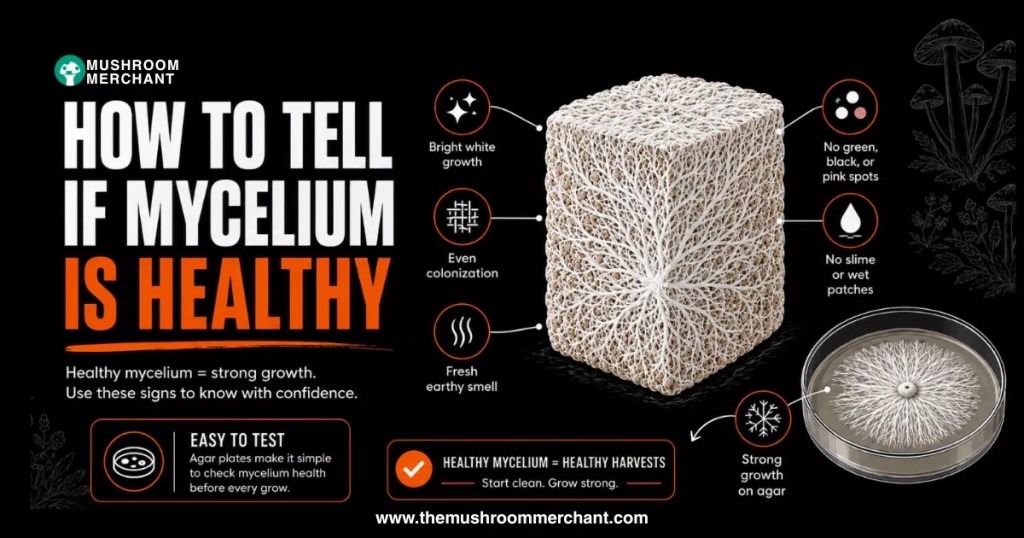
Healthy mycelium is essential for successful mushroom cultivation. Whether you’re growing from agar, grain, or a grow kit, knowing what healthy mycelium looks like can help you avoid contamination, low yields, or stalled growth. In this guide, you’ll learn how to tell if mycelium is healthy, and what contamination looks like.
Healthy mycelium appears bright white and has a consistent, uniform growth pattern. It should spread outward in a radial fashion from the inoculation point and gradually colonize the entire substrate or plate.
Other key characteristics:
Species like lion’s mane may have wispy or fuzzy mycelium, while oyster mushrooms are typically thicker and rope-like. Know what’s normal for your strain. With practice you will learn how to tell if mycelium is healthy just by a quick glance.
Unhealthy or contaminated mycelium is often easy to spot once you know the signs. Warning indicators include:
If you see any of these signs, isolate the affected container immediately and avoid opening it in your grow space.
Several factors can lead to poor mycelium health:
Always sterilize equipment, store spores properly, and maintain good airflow and stable temperatures in your incubation area.
Understanding the difference between rhizomorphic and tomentose mycelium can help you assess growth quality more accurately.
Rhizomorphic mycelium is characterized by thick, rope-like strands that spread outward in well-defined lines. This growth is often considered a sign of vigorous, healthy colonization. It’s most commonly seen in aggressive strains or under ideal conditions.
Tomentose mycelium, by contrast, looks more fluffy, fuzzy, or cotton-like. While some growers assume tomentose growth is a problem, it is not necessarily a bad sign. Certain species naturally produce tomentose growth, and environmental conditions like lower humidity or limited airflow can also cause it.

The type of mycelial growth can vary depending on:
Rhizomorphic mycelium is often preferred when selecting strains on agar, as it tends to perform better in bulk substrate and fruit more aggressively. However, both types are normal, and health should ultimately be judged by consistency, color, and absence of contamination instead of texture alone.
Here are a few best practices for encouraging strong, healthy mycelium:
With proper care, you can maintain a clean growing environment and ensure vigorous colonization.
Learning how to tell if mycelium is healthy is one of the most valuable skills for any mushroom grower. It allows you to catch problems early, make better decisions, and improve your overall success rate. Keep an eye on color, texture, and smell, and trust your instincts when something seems off.
Healthy mycelium is usually easy to spot once you know what to look for: clean, consistent growth, a fresh earthy smell, and no strange colors, slime, or fuzzy contamination patches. For an easy way to check vigor before expanding a culture, you can test a small sample on agar plates and watch how it grows over the next few days. An easy-to-prepare option like Mushroom Merchant Agar Premix makes this simple, giving growers a convenient tool for confirming clean, healthy mycelium before moving forward.
Healthy mycelium is bright white, spreads evenly, and appears dense or rope-like depending on the mushroom species. It should not have any discoloration, slimy areas, or odd smells.
Fluffy mycelium can be normal, especially in high-humidity environments, but it can also indicate stress or excess CO2. If growth is otherwise strong and uncontaminated, it’s usually not a problem.
Mycelium is typically pure white. Any green, blue, yellow, pink, or black growth is likely a sign of contamination and should be removed or discarded.
Under optimal conditions, mycelium should show visible growth within 2–5 days after inoculation and fully colonize a grain bag or agar plate in 10–21 days depending on the species.
A sour or rotting smell indicates bacterial contamination. This is a sign that the substrate or plate should be discarded to avoid spreading contamination to other grows.
Learn More About Mycology
Get updates and learn about growing mushrooms