📦FREE SHIPPING ON ALL ORDERS🍄 Dismiss
Skip to content

Choosing a mushroom substrate starts with the species you want to grow. Lion’s mane, oyster mushrooms, shiitake, and button mushrooms do not all use the same growing materials.
This guide compares common substrates for edible mushroom cultivation and explains where hardwood, straw, wood chips, compost, and CVG fit.
Substrate is the material mycelium grows through and uses during cultivation. Its ingredients influence the available nutrition, moisture, and physical structure.
A suitable substrate must match both the mushroom species and the growing method. A material that supports visible mycelium growth does not necessarily produce a productive mushroom crop.
These are general cultivation recommendations. The exact formula, mushroom strain, and growing conditions affect results.
| Mushroom | Scientific name | Commonly used growing substrate |
|---|---|---|
| Oyster | Pleurotus ostreatus | Prepared straw or hardwood-based substrate |
| King oyster / king trumpet | Pleurotus eryngii | Supplemented sawdust or hardwood-based blocks |
| Lion’s mane | Hericium erinaceus | Supplemented hardwood sawdust blocks or suitable hardwood logs |
| Shiitake | Lentinula edodes | Suitable hardwood logs or supplemented hardwood sawdust blocks |
| Chestnut | Pholiota adiposa | Supplemented sawdust or hardwood-based blocks |
| Maitake | Grifola frondosa | Supplemented sawdust or hardwood-based blocks |
| Wine cap / garden giant | Stropharia rugosoannulata | Outdoor hardwood-chip or straw beds |
| Button, cremini, and portobello | Agaricus bisporus | Prepared mushroom compost with a separate casing layer |
Before choosing a product, check its ingredients against the recommendations for your particular strain. Hardwood type, supplements, preparation, and growing conditions all affect suitability.
Hardwood sawdust and pellets are commonly used as the base of indoor gourmet mushroom blocks. Some formulas include supplements such as bran or soybean hulls.
Lion’s mane, shiitake, king oyster, chestnut, and maitake are commonly cultivated on wood-based formulas. Oyster mushrooms can also be grown on hardwood-based substrate.
Plain hardwood and supplemented hardwood are different formulas. Do not assume a bag contains bran or soybean hulls unless those ingredients are listed.
Mushroom Merchant Hardwood Substrate arrives hydrated and sterilized. Check the product information and included instructions when selecting it for your edible mushroom project.
Prepared straw is an established substrate for oyster mushrooms. Its preparation and handling differ from those of sterilized hardwood blocks.
Hardwood chips are commonly used for outdoor wine cap beds. An outdoor chip bed and an indoor sawdust block are different growing systems, even though both contain wood.
Button, cremini, and portobello mushrooms are forms of Agaricus bisporus. Their usual cultivation system uses prepared mushroom compost and a separate casing layer.
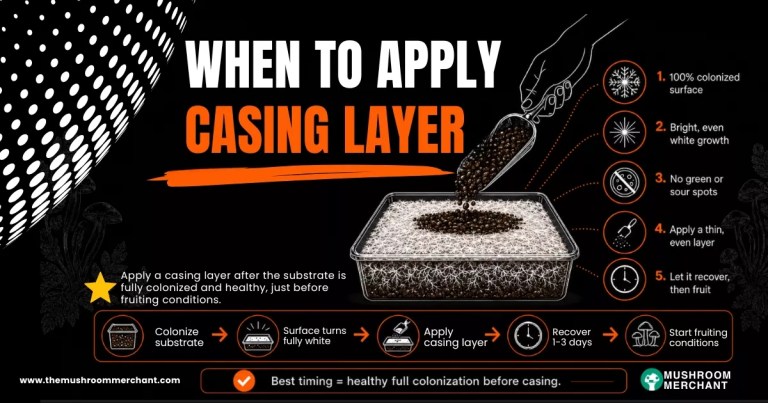
Our Casing Layer comes prepared and ready to apply over colonized substrate when your edible mushroom growing method calls for a separate casing layer.
Casing is a surface layer used in certain cultivation methods. It does not replace the underlying growing substrate.
Basic CVG and hardwood bags should not be treated as direct replacements for prepared Agaricus compost.
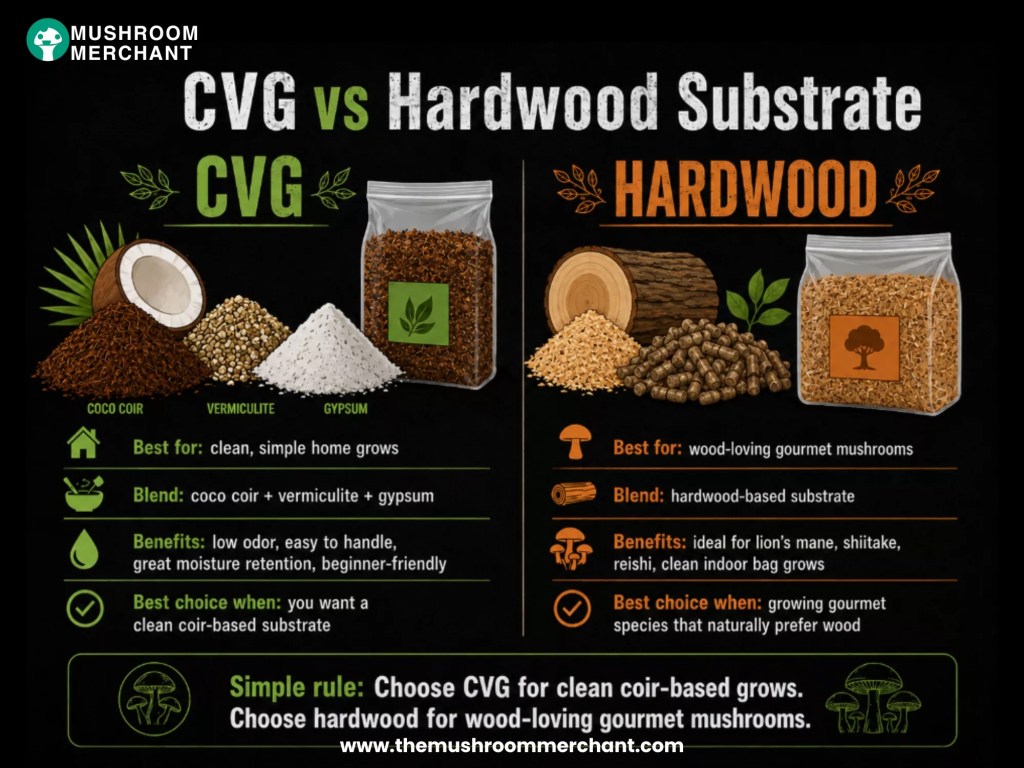
CVG stands for coco coir, vermiculite, and gypsum. Mushroom Merchant CVG Substrate contains those ingredients and water.
Coco coir provides the base material, vermiculite helps retain moisture, and gypsum supplies calcium and sulfur.
Some growers prefer CVG for its low odor and convenient handling compared with manure-based materials. The choice still depends on the species and growing method, since these substrates are not interchangeable. Cleaner handling does not mean a substrate is contamination-proof or nutritionally equivalent to compost.
For edible mushroom cultivation, choose CVG when you have a tested method for the species, strain, and formula you intend to use. Basic CVG should not be treated as a general replacement for the substrates listed in the species table.
Grain spawn is grain that has been colonized by mushroom mycelium. It is used to introduce that mycelium into a suitable growing substrate.
Our Sterilized Rye Grain Bags contain prepared grain without mushroom culture. After inoculation with an edible mushroom culture and full colonization, the grain can be used as spawn.
An uninoculated substrate bag also differs from a ready-to-fruit block, which already contains established mycelium.
Preparation depends on the formula and growing method. Straw is often pasteurized, while nutrient-supplemented sawdust is commonly sterilized.
Our prepared hardwood and CVG bags arrive hydrated and sterilized. Follow the included instructions and use clean handling when adding colonized spawn. Adding raw ingredients changes the formula and may require additional preparation.
Identify the mushroom species first, then choose the substrate formula and growing method recommended for that strain.
Choose products by their listed ingredients and intended use, rather than assuming that every bag labeled “mushroom substrate” is interchangeable.
For the wood-loving edible mushrooms listed above, hardwood-based formulas are the established choice. CVG is a different blend and should be selected only when it fits a tested growing method.
Research has demonstrated oyster mushroom cultivation using certain coconut-based formulas. The ingredients and preparation vary between studies, so those results should not be assumed to apply to every CVG blend.
No. A casing layer is applied over colonized substrate in growing methods that call for it. It serves a different role from the underlying substrate.
No. Our Sterilized Rye Grain Bags do not contain mushroom culture. They become grain spawn after inoculation and colonization with your chosen edible mushroom culture.
Our hardwood and CVG substrate bags are hydrated and sterilized, but they are not colonized mushroom blocks. They require compatible spawn and the appropriate colonization and fruiting conditions.
The best mushroom substrate for beginners is usually a clean, ready-to-use substrate bag. CVG is a simple option for compatible coir-based grow styles, while hardwood substrate is better for gourmet wood-loving mushrooms like lion’s mane, shiitake, and reishi.
CVG substrate is a blend of coco coir, vermiculite, and gypsum. It is popular because it holds moisture well, has a clean texture, and is easy to use in home mushroom growing setups.
Hardwood substrate is better for wood-loving mushrooms such as lion’s mane, shiitake, and reishi. CVG is easier to handle and works well for compatible grow styles, but it is not the best choice for every mushroom species.
Most beginners are better off avoiding manure-based substrates. They can be messier, stronger smelling, and harder to prepare consistently. Cleaner options like CVG and hardwood substrate are usually easier for home growers.
Straw can work for some mushroom growing methods, especially oyster mushrooms, but it is often messier and more labor-intensive than prepared substrate bags. For many home growers, CVG or hardwood substrate is a cleaner and simpler choice.
Some mushroom substrates need sterilization, while others are pasteurized. Supplemented hardwood substrates usually need sterilization because they contain more nutrients. Ready-to-use substrate bags are already prepared and do not need extra processing before use.
Spent mushroom substrate should not usually be reused for a new grow. After a flush, the substrate has fewer available nutrients and a higher chance of contamination. It can often be composted or used in the garden instead.
Learn More About Mycology
Get updates and learn about growing mushrooms