CVG substrate is a bulk mushroom substrate made from coco coir, vermiculite, and gypsum. It is commonly mixed with fully colonized grain spawn to give mushroom mycelium more water, structure, and growing space before fruiting.
For many growers, CVG is one of the easiest bulk substrates to understand. It does not require manure, compost, straw processing, or complicated supplement blends. The ingredients are easy to handle, the texture is forgiving, and the process can be repeated once the moisture level is right.
CVG is not usually used by itself. The grain spawn provides most of the nutrition, while the CVG acts as the hydrated bulk material that the mycelium spreads through.
CVG stands for coco coir, vermiculite, and gypsum.
| Ingredient | What It Does |
|---|---|
| Coco coir | Provides the main base and structure |
| Vermiculite | Helps hold moisture and improve texture |
| Gypsum | Adds calcium and sulfur while helping reduce clumping |
Together, these ingredients create a loose, hydrated substrate that is easy to mix with colonized grain spawn.
Coco coir is made from coconut husk fiber. In CVG substrate, it is the main base material.
Coco coir is popular because it holds moisture well, is easy to break apart when hydrated, and has a cleaner feel than many traditional substrate materials. It gives the substrate body without adding a heavy nutrient load.
That matters because CVG is usually paired with colonized grain. The grain is the nutrient source. The coco coir gives the mycelium a larger hydrated material to colonize.
Vermiculite is a lightweight mineral material that helps the substrate hold water.
When mixed with coco coir, it helps keep the substrate from becoming too dense. Good CVG should feel moist and airy, not muddy or compacted. Vermiculite helps create that balanced texture.
It also helps the substrate hold moisture more evenly, which can make colonization and fruiting conditions easier to manage.
Gypsum is calcium sulfate dihydrate. In CVG substrate, it is used in a small amount compared to coco coir and vermiculite.
Gypsum helps improve the feel of the substrate and can reduce clumping. It also adds calcium and sulfur, which are common minerals used in mushroom growing substrates.
Gypsum is not the main food source. It is a support ingredient that helps the mix handle better and stay more consistent.
Gypsum Dosage: Use gypsum at approximately 5–10% of the total dry substrate weight. Mix thoroughly with the coco coir and vermiculite before adding water to ensure even distribution throughout the substrate.
CVG is used as a bulk substrate in mushroom growing.
The basic workflow is simple:
The important point is that CVG and grain spawn are not the same thing. Grain spawn is the colonized nutrient base. CVG is the bulk substrate that gives the mycelium more hydrated material to grow through.
Growers use CVG because it keeps the substrate process manageable.
Many substrate recipes include materials that are harder to store, harder to prepare, or messier to handle. CVG keeps things more straightforward. Coco coir, vermiculite, and gypsum are dry ingredients that can be stored easily and mixed into a consistent substrate when needed.
CVG is also a good option for beginners because it removes a lot of unnecessary complexity. Instead of learning several substrate types at once, a grower can start with one practical bulk substrate and learn how proper hydration, mixing, colonization, and fruiting work.
CVG is not highly nutritious by itself.
Most of the nutrition in a CVG grow usually comes from the colonized grain spawn. The CVG provides moisture, structure, and expansion space.
This is one reason CVG is often seen as forgiving. Since it is not as nutrient-heavy as some supplemented substrates, it can be easier to manage when used correctly.
Good CVG should be evenly mixed, hydrated, and loose enough for mycelium to move through.
| Good CVG | Problem CVG |
|---|---|
| Moist but not dripping | Too wet or muddy |
| Light and fluffy | Dense or compacted |
| Evenly mixed | Dry chunks or uneven texture |
| Earthy, clean smell | Sour or foul odor |
| Holds moisture evenly | Water pooling or dry pockets |
A simple way to think about it: CVG should feel hydrated, but it should not feel like mud. If it is dripping wet or packed too tightly, the texture is off.
There are many mushroom substrate options, but not all of them are equally practical for beginners or small-scale growers.
| Substrate Type | Common Use | Notes |
|---|---|---|
| CVG | General bulk substrate workflows | Clean, simple, and easy to handle |
| Hardwood substrate | Wood-loving mushrooms | Often used for species like oyster and lion’s mane |
| Straw | Some fast-growing species | Can be bulky and messier to process |
| Manure-based substrate | Traditional dung-loving species | Messier and less convenient for many growers |
For most practical growing setups, CVG and hardwood substrate are two of the easiest substrate categories to understand.
CVG is useful as a simple bulk substrate. Hardwood substrate is better suited for many wood-loving gourmet mushrooms. Straw and manure-based substrates can be used in some growing methods, but they usually add more mess, handling, and preparation steps.
CVG can be prepared in different ways depending on the grower’s process.
Some growers hydrate and pasteurize CVG themselves. Others prefer ready-to-use CVG that has already been prepared, sealed, and handled in a more controlled workflow.
The best option depends on the grower’s setup. Making CVG yourself can be cost-effective, but it takes time, space, and cleanup. Ready-to-use CVG can be helpful when you want fewer prep steps and a more consistent starting point.
Preparing CVG substrate at home requires three basic ingredients, water, and a suitable mixing container. The following steps outline a simple preparation process.
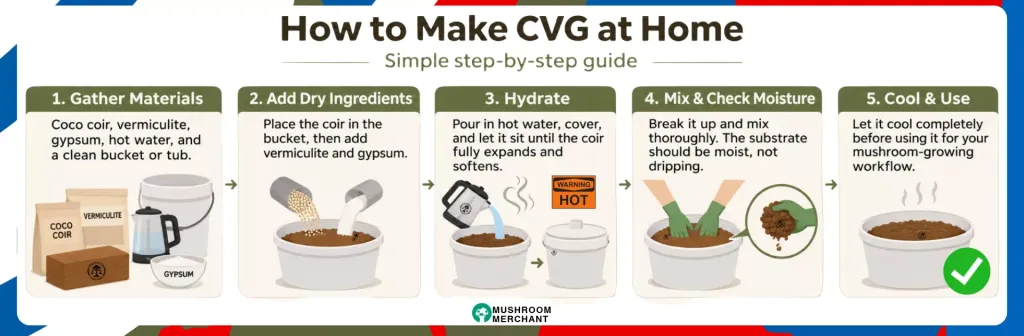
Gather coco coir, vermiculite, gypsum, hot water, and a clean, heat-resistant bucket or container.
Place the coco coir into the container, followed by the vermiculite and gypsum.
Carefully add hot water, cover the container, and allow the coco coir to fully expand and soften.
Once the substrate has cooled enough to handle safely, break apart any remaining clumps and mix thoroughly. The finished substrate should be evenly hydrated without excessive moisture or pooling water.
Allow the substrate to cool completely. Follow the appropriate substrate treatment and preparation requirements for the mushroom species being cultivated before use.
Tip: Properly prepared CVG should have a light, loose, and evenly hydrated texture. Hydration alone does not guarantee sterilization or pasteurization.
Overly wet CVG can become heavy, muddy, and harder for mycelium to colonize evenly. The substrate should be hydrated, but it should not be dripping or pooling water.
Coco coir needs time to fully hydrate and break apart. Dry chunks can create uneven moisture and inconsistent texture in the final substrate.
CVG should have structure. If it is smashed down too hard, it can become dense and restrict healthy growth. A lightly leveled substrate is usually better than one that has been heavily compacted.
CVG is not a replacement for grain spawn. It is mixed with colonized grain after the grain has already been fully colonized. The grain provides the main nutrition, and the CVG provides the hydrated bulk material.
Yes. CVG is one of the most beginner-friendly bulk substrates because it uses simple ingredients and avoids many of the messier parts of substrate preparation.
A beginner does not need to handle manure, compost, or complicated supplement recipes to understand CVG. The main things to learn are proper hydration, even mixing, and clean handling.
CVG is also useful beyond beginner growing. Once a grower has a process that works, CVG is easy to repeat and scale.
Many growers start by making CVG themselves. That can work well, especially if you already have space for mixing, hydration, and cleanup.
Ready-to-use CVG is useful when you want to skip the messier prep steps. Instead of breaking apart coco coir, measuring vermiculite, adding gypsum, hydrating the mix, and cleaning up afterward, you can start with substrate that is already mixed and prepared.
This is especially helpful for small grows, beginner grows, or anyone who wants a more convenient workflow.
If you are using ready-to-use CVG, make sure the substrate looks evenly hydrated, has a clean earthy smell, and is packaged in a way that protects it until use.
CVG substrate is a bulk mushroom substrate made from coco coir, vermiculite, and gypsum.
It is popular because it keeps the substrate process simple. Coco coir provides the base, vermiculite helps hold moisture, and gypsum improves texture and mineral balance. When mixed with fully colonized grain spawn, CVG gives mushroom mycelium a hydrated material to spread through before fruiting.
For many growers, CVG is one of the easiest substrates to learn, repeat, and keep consistent.
CVG substrate means a mushroom growing substrate made from coco coir, vermiculite, and gypsum. The name comes from the first letter of each ingredient.
CVG substrate is used as a bulk substrate for mushroom growing. It is usually mixed with fully colonized grain spawn so the mycelium can spread through a larger hydrated material before fruiting.
No. CVG and grain spawn are different. Grain spawn is colonized grain that provides nutrition. CVG is the bulk substrate that adds moisture, structure, and growing space.
CVG is not highly nutritious by itself. Most of the nutrition usually comes from the grain spawn. CVG mainly provides water, texture, and space for mycelium to expand.
Traditional CVG includes gypsum. Gypsum helps improve texture, reduce clumping, and add calcium and sulfur. Some growers use coco coir and vermiculite without gypsum, but that is not technically the full CVG recipe.
CVG is cleaner and easier to handle for many growers. Manure-based substrates can be used in some methods, but they are messier and less convenient. For beginners, CVG is usually the more practical option.
Good CVG should feel moist, loose, and evenly mixed. It should not be dripping wet, muddy, sour-smelling, or packed into a dense block.
Yes. CVG is a good beginner substrate because the ingredients are simple and the process is easy to understand. It is one of the most common bulk substrates for growers learning how to work with grain spawn and substrate.
Learn More About Mycology
Get updates and learn about growing mushrooms