📦FREE SHIPPING ON ALL ORDERS🍄 Dismiss
Skip to content

Mushroom contamination occurs when unwanted molds, bacteria, yeasts, or other microorganisms begin growing alongside or instead of mushroom mycelium.
Contaminants can be introduced through the air, tools, surfaces, cultures, grain, substrate, or handling.
The best way to deal with contamination is to prevent it before it starts.
In general:
In most cases, visibly contaminated mushroom material should be discarded.
Removing a visible patch does not guarantee that the remaining material is clean. Mold, bacteria, or other microorganisms may already be present beyond the area you can see.
Trying to recover contaminated grain or substrate can also increase the chance of spreading contamination to nearby projects.
If clear contamination appears, keep the material contained and dispose of it.
Clean handling is important, but surface cleaning cannot correct contaminated grain, substrate, or culture.
Good contamination control starts with:
The goal is not to make an entire room sterile. The goal is to reduce unnecessary exposure during the parts of the process where contamination is most likely to be introduced.
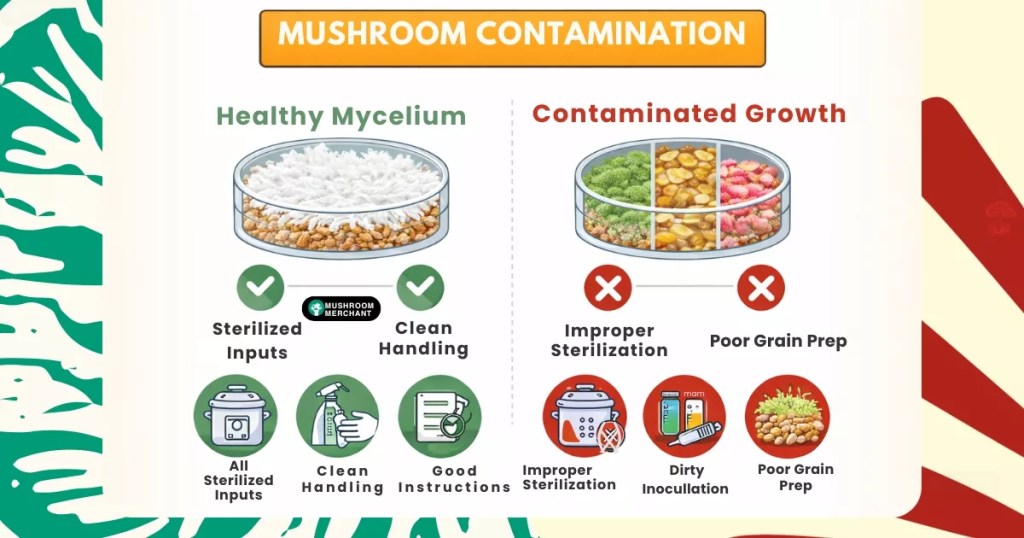
The following are some common signs of contamination growers may encounter.
If green mold is clearly present, keep the material sealed and dispose of it.
Keep clearly contaminated material sealed and dispose of it.
Avoid opening moldy material indoors when possible.
Gray growth can sometimes be confused with mushroom mycelium, especially early in development.
If the growth looks unusual, spreads very quickly, or develops an abnormal color or odor, isolate the material and inspect it carefully.
If contamination is clear, dispose of it.
Bacterial contamination generally cannot be corrected once it becomes established.
If bacterial contamination is clearly present, keep the material sealed and dispose of it.
Unusual pink or red growth should be treated as contamination.
Keep the material contained and dispose of it.
If yeast contamination is clearly present, the material should generally be discarded.
Healthy mycelium is usually white, although its appearance can vary between mushroom species.
Healthy mycelium may appear:
Possible signs of contamination include:
If you are unsure, avoid opening the material until you can identify the issue more confidently.
Contamination can come from several sources.
Common causes include:
Contamination can occur at more than one stage, so it is important to consider the entire process rather than assuming there is a single cause.
Grain is nutrient-rich and can support unwanted microorganisms if it is not prepared correctly.
Proper grain preparation includes:
Excess moisture, incomplete sterilization, damaged packaging, or contaminated culture can all contribute to problems later.
Using professionally prepared grain can reduce the number of preparation steps and help improve consistency.
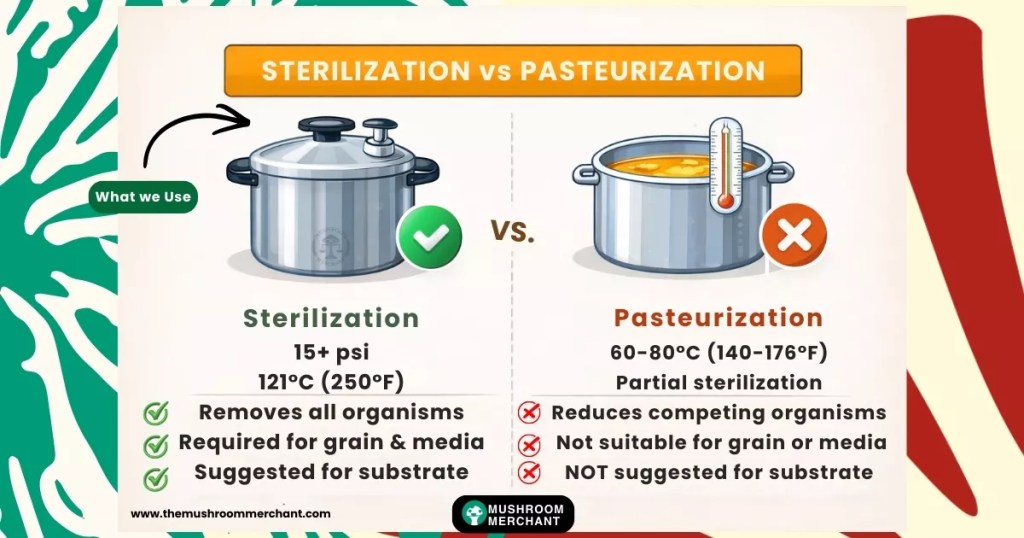
Sterilization and pasteurization are different processes and are used for different materials.
Sterilization uses higher heat and pressure to prepare nutrient-rich materials such as grain and certain media.
Pasteurization uses lower temperatures and is commonly used for some bulk substrates.
The correct method depends on the material being prepared and how it will be used.
Mushroom Merchant grain and substrate comes sterilized and ready to use.
Contamination does not only come from grain or substrate.
Culture can also introduce unwanted microorganisms.
Liquid culture, agar, tools, and other materials should be handled carefully and kept clean.
Agar can be useful for observing culture growth before transferring it to grain.
This can help identify obvious contamination earlier in the process.
A clean grow area helps reduce contamination risk, especially during inoculation and other handling steps.
A practical clean workspace should have:
The goal is to reduce unnecessary exposure, not to make the entire room sterile.
The most useful prevention steps are straightforward.
Start with:
Using prepared materials can also reduce the number of steps where contamination can be introduced.
Dispose of the material if you see clear signs of contamination such as:
Keep contaminated material sealed whenever possible before disposal.
Most contamination problems can be reduced by focusing on a consistent process.
Use clean culture, properly prepared materials, clean tools, and careful handling.
Avoid unnecessary handling, excess moisture, and poorly stored materials.
Simple, repeatable steps are usually more useful than adding unnecessary complexity.
Contamination is a common part of mushroom cultivation, but many problems can be prevented with clean materials and careful handling.
If contamination becomes clearly visible, keep the material contained, dispose of it, clean the work area, and start again with fresh materials.
Improving the process that caused the problem is usually more useful than trying to recover material that is already compromised. Using clean inputs such as Sterilized Rye Grain greatly increases your chances of a successful harvest.
The most common type of mushroom contamination is green mold, also known as Trichoderma, which is highly aggressive and often originates from improperly sterilized grain.
Contaminated mushroom grows cannot be reliably saved or fixed, and the safest and most effective action is to discard them immediately.
Mushroom contamination often starts in grain because grain is nutrient-dense and must be fully sterilized, and even small preparation errors can allow bacteria or mold to survive inside the kernels.
Spore syringes and liquid culture can cause contamination if they are improperly prepared or handled, which is why many growers test them on agar before using them.
Breathing mold spores from contaminated mushroom grows can be harmful, so contaminated materials should not be opened indoors.
Buying professionally prepared grain and substrate significantly reduces contamination risk because these materials are properly sterilized in controlled, lab-grade environments.
A mushroom grow area needs to be reasonably clean, with minimal dust and no visible mold, but it does not need to be sterile like a laboratory.
Sterilization eliminates all living organisms and spores and is required for grain and nutrient-rich materials, while pasteurization only reduces competing organisms and is used for select bulk substrates.
A contaminated mushroom grow should be thrown away as soon as mold, sour odors, slimy grain, or abnormal growth is observed.
Learn More About Mycology
Get updates and learn about growing mushrooms