📦FREE SHIPPING ON ALL ORDERS🍄 Dismiss
Skip to content

Choosing the right mushroom substrate is one of the most important parts of a successful grow. Substrate is the material mushroom mycelium grows through after it has been introduced to a prepared growing medium. It provides moisture, structure, and, depending on the formula, nutrition for the mycelium as it colonizes.
There are many types of mushroom substrate, including straw, manure-based mixes, coco coir blends, and hardwood blends. For most home growers, though, the practical choice usually comes down to two clean and reliable options: CVG substrate or hardwood substrate.
CVG is a coir-based blend that is simple, low odor, and easy to handle. Hardwood substrate is the better match for many gourmet wood-loving mushrooms like lion’s mane, shiitake, reishi, and similar species.
This guide explains the main substrate types, when each one is used, and why CVG and hardwood blends are often the easiest choices for clean home mushroom growing.
Mushroom substrate is the material that supports mycelium growth. After spawn is added, the mycelium spreads through the substrate and uses the available moisture, structure, and nutrients to continue developing.
Common mushroom substrate materials include coco coir, vermiculite, gypsum, hardwood sawdust, hardwood pellets, straw, and other organic materials.
A good substrate should hold moisture evenly, allow airflow through the material, resist becoming too compacted, and match the needs of the mushroom species being grown.
For clean home growing, CVG and hardwood-based blends are usually the most practical options. They are easier to store, easier to handle, and better suited for a simple indoor workflow than many messier substrate types.
Substrate affects almost every part of the mushroom growing process. The right substrate can help support steady colonization, better moisture retention, cleaner handling, and more consistent results.
The wrong substrate can create problems. It may dry out too quickly, hold too much water, become too dense, or fail to provide the type of material the species prefers.
For beginners, the best substrate is usually the one that is clean, simple, and easy to use consistently. A substrate does not need to be complicated to work well. It needs to match the grow.
That is why many home growers are best served by choosing between two main substrate categories:
CVG substrate for simple coir-based growing methods.
Hardwood substrate for gourmet wood-loving mushrooms.
Most growers do not need to compare every possible substrate type. For clean home growing, it usually makes more sense to choose between CVG and hardwood substrate.
CVG is a practical option when you want a clean, low-odor, easy-handling substrate. It works well for compatible grow styles and is one of the most beginner-friendly substrate blends.
Hardwood substrate is the better choice for many gourmet mushrooms that naturally grow on wood. Lion’s mane, shiitake, reishi, and many other gourmet species are better matched to hardwood-based material.
Other substrates exist, but they are not always ideal for clean indoor growing. Straw can be messy and labor-intensive. Manure-based mixes require more careful handling and are not the direction most home growers need to go.
If your goal is a cleaner and more beginner-friendly process, start by choosing either CVG or hardwood substrate.
CVG stands for coco coir, vermiculite, and gypsum.
Coco coir holds moisture and gives the substrate its base structure. Vermiculite helps improve water retention and texture. Gypsum adds calcium and sulfur while helping the mix stay workable.
CVG is popular because it is clean, simple, low odor, and easy to handle. It is commonly used in grow bags and tub-style growing methods.
CVG is not the best substrate for every mushroom species, but it is one of the most beginner-friendly substrate blends for compatible grow styles.
CVG is a strong option for growers who want a clean and simple substrate without dealing with messier organic materials.
CVG is popular because it is:
Easy to handle
Low odor
Simple to hydrate and mix
Good at holding moisture
Clean compared to many traditional substrate options
Beginner-friendly for compatible grow styles
For many home growers, CVG is the easiest substrate category to understand and work with. It creates a simple foundation without adding unnecessary complexity.
Hardwood substrate is made from hardwood sawdust, hardwood pellets, or similar wood-based materials. It is commonly used for gourmet mushrooms that naturally grow on dead or decaying wood.
Many gourmet mushrooms perform best on hardwood because it more closely matches their natural growing environment.
Hardwood substrate is commonly used for lion’s mane, shiitake, reishi, chestnut mushrooms, and some oyster varieties.
When hardwood substrate is supplemented with nutrient-rich ingredients, it usually requires proper sterilization. This is one reason many home growers prefer ready-to-use hardwood substrate bags instead of preparing everything from scratch.
Hardwood substrate is the better choice for many gourmet wood-loving mushrooms.
It gives wood-loving species a more appropriate growing medium than basic coir-based blends. If a mushroom naturally grows on wood, hardwood substrate is usually the right direction.
Hardwood substrate is especially useful for growers who want to grow gourmet mushrooms in bags. It is clean, compact, and well suited for indoor mushroom cultivation when properly prepared.
For gourmet home growing, hardwood substrate is one of the most important substrate types to understand.
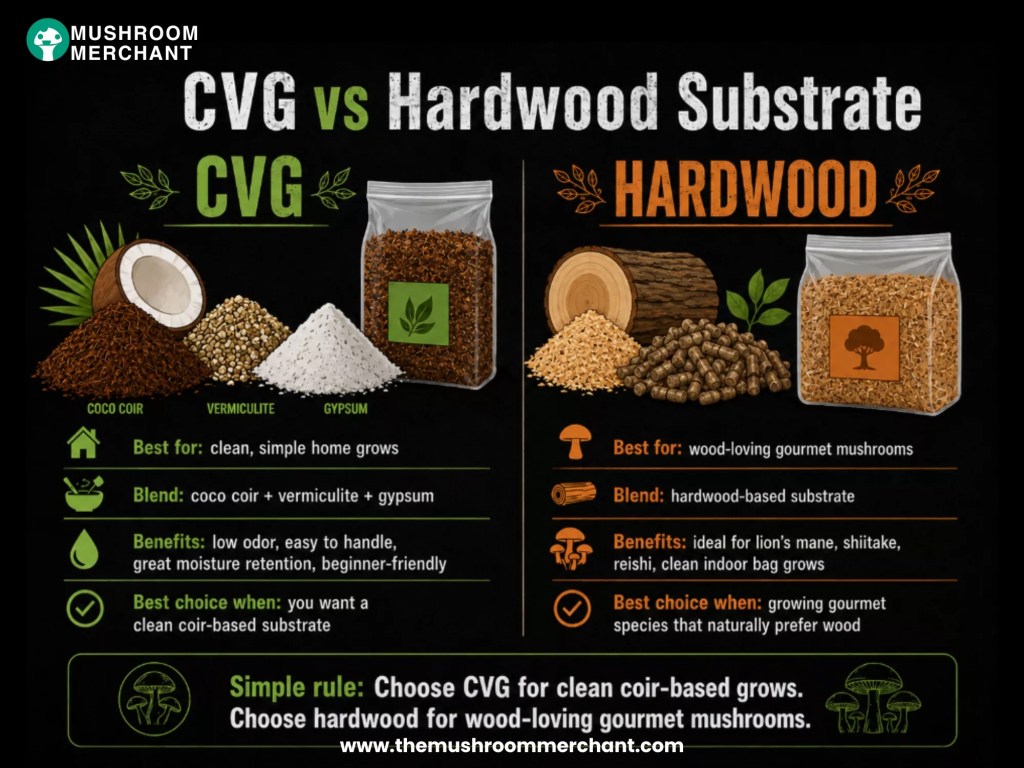
CVG and hardwood substrate are both useful, but they serve different purposes.
CVG is usually easier to handle. It is clean, low odor, and simple to use. It is a strong option for compatible grow styles where moisture retention and easy handling matter.
Hardwood substrate is better for wood-loving gourmet mushrooms. Lion’s mane, shiitake, reishi, and similar species usually perform better on hardwood-based material than on basic coir-based blends.
The best choice depends on the species. If the mushroom naturally grows on wood, choose hardwood. If your grow method is designed around a coir-based substrate, CVG may be the better fit.
For most home growers, this is the most useful way to think about substrate:
Choose CVG when you want a clean, simple coir-based substrate.
Choose hardwood when growing gourmet wood-loving mushrooms.
Coco coir is made from coconut husk fiber. It is widely used in mushroom growing because it holds moisture well and has a light, workable texture.
Coco coir is easy to hydrate, low odor, and relatively clean to handle. It works especially well as the base material in CVG substrate.
Coco coir is useful, but it is not automatically the best option for every species. Wood-loving gourmet mushrooms usually need hardwood-based material instead.
Vermiculite is often added to coir-based substrate blends to improve water retention and structure.
It helps the substrate hold moisture more evenly and reduces compaction. This makes the substrate easier for mycelium to move through.
In CVG, vermiculite helps create a more balanced texture and supports more even hydration.
Gypsum is calcium sulfate. It is commonly added to mushroom substrate formulas in small amounts.
Gypsum can help improve texture, reduce clumping, and add calcium and sulfur. It is not the main food source in the substrate, but it is a useful additive in many blends.
Gypsum is commonly used in CVG, grain preparation, and other mushroom growing formulas.
Hardwood is the preferred base for many gourmet mushrooms.
Hardwood substrate is commonly used for lion’s mane, shiitake, reishi, chestnut mushrooms, and some oyster varieties.
Hardwood pellets are often used because they are compact, easy to store, and simple to hydrate. Hardwood sawdust can also be used, especially in commercial or larger-scale growing.
For many home growers, ready-to-use hardwood substrate bags are easier than sourcing, hydrating, supplementing, and sterilizing hardwood materials from scratch.
Straw is a traditional substrate used for some mushroom growing methods, especially oyster mushroom cultivation.
However, straw is not always the easiest option for home growers. It often needs to be chopped, hydrated, pasteurized, drained, and packed properly before use. It can also be messier to handle indoors compared to prepared substrate bags.
Straw can work, but it is usually not the cleanest or simplest choice for a beginner home setup. Many growers prefer a cleaner option like CVG or hardwood substrate because these materials are easier to store, handle, and use consistently.
Manure-based substrates are used in some mushroom growing methods, but they are usually not the cleanest or simplest option for beginners.
They can have stronger odor, require more careful preparation, and be harder to manage consistently in a home environment. They also require proper processing before use.
For most home growers, manure-based mixes add unnecessary complexity. Cleaner substrate options like CVG and hardwood blends are easier to store, easier to handle, and better suited for a simple indoor workflow.
If your goal is a clean home grow, CVG and hardwood substrate are usually the better direction.
Oyster mushrooms are aggressive growers and are often considered one of the easier gourmet mushrooms for beginners.
Oyster mushrooms can grow on straw, hardwood, and other prepared substrates. Straw is a traditional option, but it can be messy and labor-intensive for home growers.
For a cleaner indoor workflow, many growers prefer hardwood-based substrate or a ready-to-use grow bag format. Hardwood substrate can be a practical choice for oyster mushrooms, especially when the goal is cleaner handling and more controlled preparation.
Lion’s mane is a wood-loving gourmet mushroom. It generally performs best on hardwood-based substrates that mimic the type of material it would naturally grow on.
Good substrate options for lion’s mane include hardwood sawdust, hardwood pellets, and supplemented hardwood blocks.
Lion’s mane is usually not the best match for basic coir-based substrates because it prefers wood-based nutrition and structure. For better results, use a properly prepared hardwood substrate designed for gourmet mushroom growing.
Shiitake is another wood-loving mushroom that grows well on hardwood.
Good substrate options for shiitake include oak sawdust blocks, hardwood logs, and supplemented hardwood substrate.
Shiitake usually needs a denser wood-based substrate. It is not usually a good fit for simple CVG or basic coir-based mixes.
Reishi also grows well on hardwood-based material and is commonly grown in sterilized grow bags.
Good substrate options for reishi include hardwood sawdust, hardwood pellets, supplemented hardwood blocks, and logs.
Reishi can take longer to colonize than some faster-growing species, so clean preparation and proper processing are important.
The easiest mushroom substrate for beginners is usually a ready-to-use substrate bag that has already been hydrated and properly processed.
A beginner-friendly substrate should be easy to store, easy to handle, properly hydrated, and matched to the species being grown.
CVG is often one of the easiest substrates to work with because it is clean, simple, and low odor. For wood-loving gourmet mushrooms, a prepared hardwood substrate is usually the better option.
Instead of trying to manage messy or complicated substrate materials, beginners are usually better off starting with a clean substrate that fits the grow.
Whether you need to sterilize mushroom substrate depends on the substrate and how it is prepared.
Some materials are pasteurized. Others are sterilized. Supplemented hardwood substrate is usually sterilized because the added nutrients can make it more vulnerable to contamination. Ready-to-use substrate bags are already prepared and do not need additional processing before use.
If you do not have sterilization equipment, a ready-to-use substrate can save time and reduce the chance of preparation mistakes.
For most beginners, buying properly prepared CVG or hardwood substrate is simpler than trying to process raw substrate materials at home.
Before choosing a substrate, start with the mushroom species.
If the mushroom naturally grows on wood, hardwood substrate is usually the best choice. This includes many popular gourmet mushrooms like lion’s mane, shiitake, reishi, and similar species.
If your grow method is designed around a coir-based substrate, CVG may be the better choice. CVG is clean, low odor, and easy to handle.
Next, consider your equipment. If you do not have a pressure sterilizer or a dedicated preparation area, ready-to-use substrate is usually the easier option.
Finally, consider your grow environment. Clean indoor growing is easier when you avoid messy substrate materials and use a substrate that is already prepared for mushroom cultivation.
There is no single best mushroom substrate for every grow, but most home growers do not need to overcomplicate the choice.
For simple home growing, CVG is one of the cleanest and easiest substrates to work with. It is low odor, easy to handle, and works well for compatible grow styles.
For gourmet wood-loving mushrooms, hardwood substrate is usually the better choice. Mushrooms like lion’s mane, shiitake, reishi, and similar species are naturally adapted to wood-based material, so a hardwood blend gives them a more appropriate growing medium.
Straw and manure-based substrates still exist, but they are usually less convenient for the average home grower. Straw can be messy and labor-intensive. Manure-based mixes require more careful handling and are not usually the best fit for a clean indoor setup.
For most growers, the easiest path is to choose a ready-to-use substrate that fits the species: CVG for compatible coir-based grows, or hardwood substrate for gourmet wood-loving mushrooms.
For most home mushroom growers, the simplest choice is either a clean CVG substrate or a hardwood-based gourmet substrate.
CVG is a practical option for simple coir-based growing methods. Hardwood substrate is the better match for many gourmet wood-loving mushrooms.
Mushroom Merchant focuses on clean, ready-to-use mushroom growing supplies that make the process easier, more consistent, and more beginner-friendly.
Substrate is the foundation of a mushroom grow. It affects moisture, colonization, contamination resistance, and overall consistency.
Use CVG when you want a clean and simple substrate for compatible grow styles. Use hardwood substrate for wood-loving gourmet mushrooms. Avoid overcomplicating the process with messy substrate materials when a cleaner option fits your grow.
For the simplest path, choose a ready-to-use substrate that is already hydrated, properly processed, and packaged for mushroom growing.
Mushroom Merchant provides mushroom growing supplies designed to make home mushroom cultivation cleaner, simpler, and more consistent.
The best mushroom substrate for beginners is usually a clean, ready-to-use substrate bag. CVG is a simple option for compatible coir-based grow styles, while hardwood substrate is better for gourmet wood-loving mushrooms like lion’s mane, shiitake, and reishi.
CVG substrate is a blend of coco coir, vermiculite, and gypsum. It is popular because it holds moisture well, has a clean texture, and is easy to use in home mushroom growing setups.
Hardwood substrate is better for wood-loving mushrooms such as lion’s mane, shiitake, and reishi. CVG is easier to handle and works well for compatible grow styles, but it is not the best choice for every mushroom species.
Most beginners are better off avoiding manure-based substrates. They can be messier, stronger smelling, and harder to prepare consistently. Cleaner options like CVG and hardwood substrate are usually easier for home growers.
Straw can work for some mushroom growing methods, especially oyster mushrooms, but it is often messier and more labor-intensive than prepared substrate bags. For many home growers, CVG or hardwood substrate is a cleaner and simpler choice.
Some mushroom substrates need sterilization, while others are pasteurized. Supplemented hardwood substrates usually need sterilization because they contain more nutrients. Ready-to-use substrate bags are already prepared and do not need extra processing before use.
Spent mushroom substrate should not usually be reused for a new grow. After a flush, the substrate has fewer available nutrients and a higher chance of contamination. It can often be composted or used in the garden instead.
Learn More About Mycology
Get updates and learn about growing mushrooms